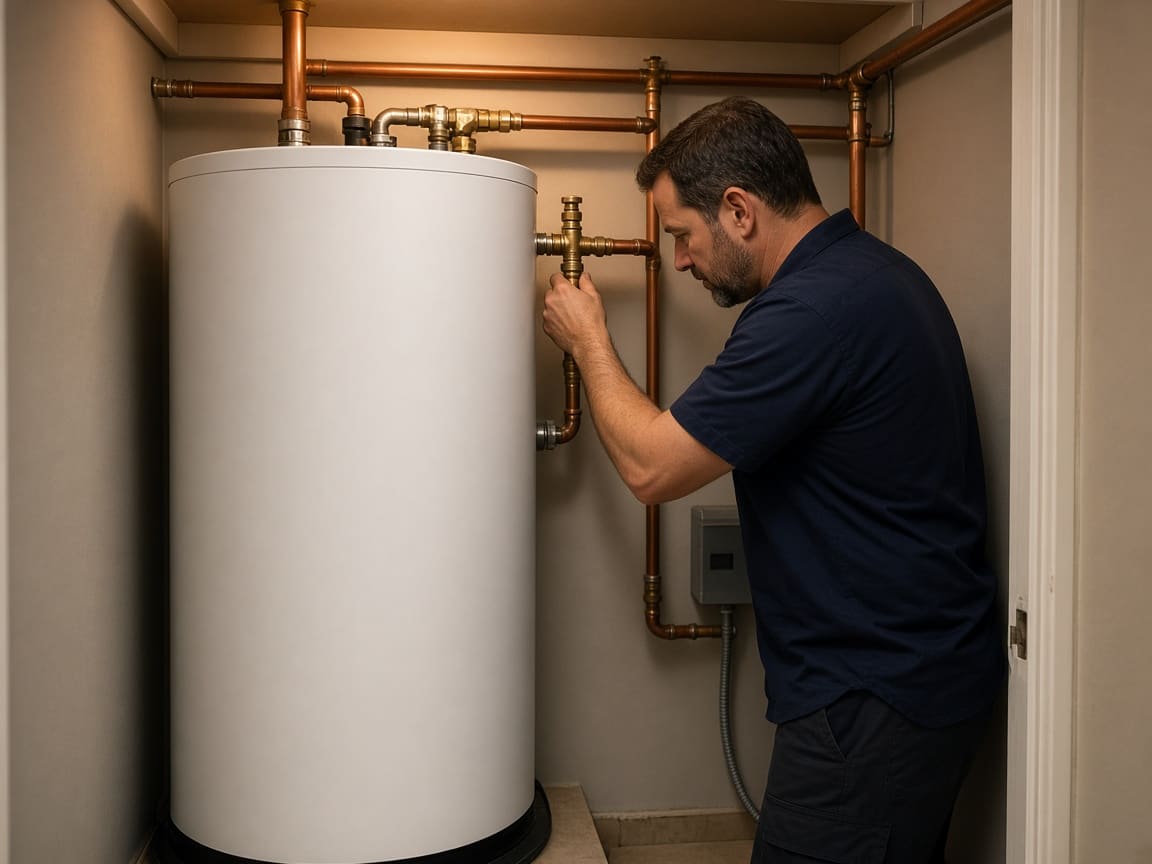
Flushing Plumbing & Heating Co. repairs and replaces water heaters in Flushing houses, Queens apartments, and small buildings. The first question on a no-hot-water call is not which new tank to buy. It is how this building makes hot water today. A lot of older houses in Flushing, Bayside, Whitestone, and Fresh Meadows do not have a standalone heater at all.
How Queens buildings actually make hot water
Three setups cover most of the calls we see.
- A storage tank. Gas or electric, in a basement, a closet, or a utility room. Common in houses that were updated, and in apartments that have their own heater.
- A tankless coil or an indirect tank on the boiler. The same boiler that heats the radiators or the baseboard also makes domestic hot water. When the heat still works and the taps run cold, the coil, the mixing valve, or the indirect tank is the thing to test. Replacing a tank that is not there does not fix it.
- A wall-hung tankless unit. These depend on gas supply, venting, and clean water passages. Scale, a failed igniter, or a vent that was never right for the unit shows up as lukewarm water or a unit that locks out.
Apartment tanks stuffed into closets are their own problem. The door, the shelf, and the flue clearance decide whether a larger tank even fits. In a co-op, the proprietary lease and the house rules often decide whether a shareholder can replace a heater, and the super has to be involved if the flue or the gas riser is the building's.
Problems we repair
- No hot water at any tap, or hot water that runs out after a few minutes.
- Rusty or milky water that shows up when the hot tap is opened and clears on the cold tap.
- Rumbling or banging from a tank that is full of sediment.
- Water on the floor from a fitting, a drain valve, a temperature-and-pressure relief valve, or the shell of the tank itself.
- A pilot or an igniter that will not stay lit, or a tankless unit that shows a code and then locks out.
- A relief valve that drips because the tank is overheating or the incoming pressure is too high. The drip is a symptom. We find which one it is.
- A flue that is loose, backdrafting, or shared in a way that is no longer safe for the appliance attached to it.
Gas, vents, and Department of Buildings filings
Plumbing work in New York City that needs a permit is filed by a master plumber licensed by the Department of Buildings. Many ordinary repairs do not need a filing. Changing gas piping, altering the flue, or doing other work the code treats as an alteration does. On a replacement we look at the vent path in these older brick buildings, the size of the gas line feeding the unit, and the shutoff. If a filing is part of the job, we say so before we start, and the licensed master plumber is who the filing is under. The gas plumbing page covers the piping itself.
A flue that spills into a living space is not a part we postpone. If we find that, we shut the appliance down and explain what has to happen before it runs again.
Backflow preventers on the water service
The water service that feeds the heater is also where some Queens buildings have a backflow preventer. The device stops water in the building from flowing back into the city main. NYC Department of Environmental Protection rules put ownership and upkeep of that device on the property owner. Reduced-pressure-zone assemblies and double-check assemblies that the rules require are tested by a New York State certified backflow tester. The initial test is filed with DEP, and the devices that require it are tested again every 12 months. The form for an annual test is signed by a licensed master plumber.
Installing the device, when DEP has required one, follows a plan from a professional engineer or a registered architect and a Department of Buildings permit filed by a licensed master plumber. We do not treat a water-heater visit as that certified test. If the basement has a preventer that looks due, or a boiler, irrigation line, or commercial use that typically needs containment, we tell you. You can read DEP's own description on the department's cross-connection control page.
How a water-heater visit works
- Call 929-499-2387 or send the quote form. Say whether you have no hot water, a leak, or both, and whether a boiler also heats the building.
- If water is actively spreading, close the cold-water shutoff above the heater if you can do it safely, and call. That is an emergency plumbing visit, including nights and weekends.
- We identify the equipment that is actually there: tank, tankless, coil, or indirect tank.
- We explain what failed and what a repair would do versus a replacement. You get a free on-site estimate before we replace the unit.
- If the replacement changes gas piping or the vent in a way that needs a permit, we tell you that as part of the estimate, not after the old unit is already gone.
What changes the cost
There is no flat figure on this page. The cost turns on the type of heater, the condition of the vent and the chimney, the gas supply to the unit, how hard the location is to reach, the condition of the water piping we have to reconnect, and whether a code item at the heater has to be corrected for the new unit to be installed safely. A boiler coil is a different job from a closet tank. A permit, when one is required, is part of the scope we describe. Hauling the old unit out of a basement with a narrow stair is also part of the job, and we include it rather than leaving the old tank behind. You see the scope before work starts.
Call if the tank is leaking
A slow drip still ruins a ceiling and a floor. Call 929-499-2387. If it can wait for a weekday visit, the contact form is the quote request.
Questions
The heat works, but the showers are cold. Is the water heater broken?
In many older Queens houses there is no separate water heater. The boiler makes the heat and also makes the hot water, through a tankless coil in the boiler or an indirect tank beside it. If the radiators are hot and the taps are cold, we look at that coil or tank before we assume you need a new standalone heater.
Do you replace tank and tankless water heaters?
Yes. We repair and replace storage tanks and tankless units, and we also work on the boiler-side equipment that makes domestic hot water. The right replacement depends on the vent, the gas supply, the space, and the condition of the water piping, not on a default model.
Does a water heater replacement need a New York City permit?
Not every like-for-like repair does. When the job changes gas piping, the flue, or other piping in a way the code treats as an alteration, a master plumber licensed by the NYC Department of Buildings files the permit. We tell you that before work starts. We do not publish a license number on this site.
What is a backflow preventer, and is that part of a heater visit?
A backflow preventer sits on the water service so water in the building cannot flow back into the city main. NYC DEP expects the owner to maintain it. Where a test is required, a New York State certified backflow tester performs it, and the result is filed with DEP. A regular plumbing visit is not a substitute for that test. If we see a device that is due, or a boiler or other use that typically needs one, we say so.
There is water on the basement floor around the heater. What should I do?
If you can safely reach the shutoff valve on the cold-water pipe above the heater, close it. If water is near electrical equipment, stay clear. Then call 929-499-2387. A tank that is leaking from the shell is finished. A leaking fitting or valve may be repairable. We will not know which until we see it.
Why do you not list a price for a new water heater?
The heater itself is only part of the job. Venting, gas supply, access, the shape of the old piping, and any permit change the work. We look at the installation and give a free on-site estimate before we replace anything.